Research & Analysis

Beijing Expands Anti-Long-Arm Jurisdiction Toolkit
Member Exclusive

Beijing Expands Anti-Long-Arm Jurisdiction Toolkit

Just six days after issuing the Regulations on Industrial and Supply Chain Security (Doc. 834), China’s State Council released the Regulations on Countering Foreign States’ Improper Extraterritorial Jurisdiction (Doc. 835), another expansion of Beijing’s retaliatory toolkit. Unlike Doc. 834, which governs sectoral and commercial supply chain security and is triggered by a demonstrable harm or threat, Doc. 835 targets foreign legal pressure itself regardless of commercial impact and can therefore be invoked under a lower evidentiary threshold.

Publications

China Market Intelligence

China Market Intelligence

Member Exclusive
Short takes on policy and regulatory actions that impact the business environment.

See the articles

Washington Update

Washington Update

Member Exclusive
Weekly recaps of every noteworthy development in the US legislative and executive branches.

See the articles

Filters

Close

Filter By

Topic
Format
Publication
Date

through

24 Results Clear Filters

2915 Results

Video: The US, China and the 2016 Election

Video: The US, China and the 2016 Election

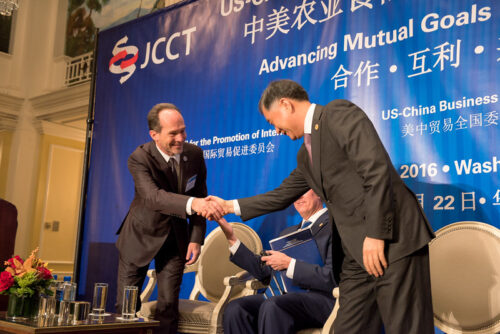
Asia Society’s high-level United Nations General Assembly-related events began with a discussion on the outlook of US-China relations after the 2016 election.

China Business Review (Archive Only) USCBC
Housing Bubble, Politics and Trouble: Problems and Policies for China’s Real Estate Market

Housing Bubble, Politics and Trouble: Problems and Policies for China’s Real Estate Market

Suppressing rising property prices is a common theme through President Xi Jinping’s speeches, the Ministry of Housing and Rural-Urban Development’s (MOHURD) policies, and Central Commission for Discipline Inspection (CCDI) campaigns. The state’s anti-corruption apparatus will continue to be deployed in tandem with Xi’s supply-side policies to reduce excess housing in small cities and deflate the housing bubble in large cities. To anticipate the direction of government policy on real estate in the near future, it is important to keep track of political developments and personnel shifts within the government, particularly conclusions from the sixth plenum of the 18th Party Congress this month and the opening of the 19th Party Congress next fall.

China Business Review (Archive Only) USCBC
New Regulations on Wage Payment Methods in Shanghai

New Regulations on Wage Payment Methods in Shanghai

According to the Shanghai Municipal Human Resource and Social Security Bureau, a new regulation on wage payment methods for Shanghai-based organizations went into effect August 1. The new regulation, issued to replace the 2003 version, expands the scope and makes several clarifications and improvements on wage calculation and standards. The new regulation is expected to minimize law disputes regarding wage issues with more specific guidance and solutions.

China Business Review (Archive Only) USCBC
Don’t Forget the Staff Handbook

Don’t Forget the Staff Handbook

Many employers in China are overlooking the importance of a staff handbook and instead are relying on an employment contracts, which often don’t include some key provisions. While an employment contract details important terms such as working hours, salary, main duties, and responsibilities, issues such as overtime rules, codes of conduct, performance standards, promotion standards, and KPIs are often omitted.

China Business Review (Archive Only) USCBC
Foreign Investment Reform Brings No New Openings

Foreign Investment Reform Brings No New Openings

In a public setback for China’s Ministry of Commerce (MOFCOM), a touted foreign investment reform reflects the continued use of the National Development and Reform Commission’s (NDRC) approach to managing inbound foreign investment and fails to include even the limited openings that MOFCOM advocated.

China Business Review (Archive Only) USCBC
City Spotlight: Investing in Hangzhou

City Spotlight: Investing in Hangzhou

Traditionally overshadowed by metropolises such as Shanghai and Beijing, Zhejiang Province’s capital city of Hangzhou found itself in the global spotlight during the G20 Summit. To beautify the city and ease congestion for its international guests, the government shut down polluting factories, shipped away migrant workers, gave citizens vouchers to encourage vacation, and spent more than $1 billion on a new convention center.

China Business Review (Archive Only) USCBC