From the first issue in 1974 and well into the 2010s, the China Business Review was an indispensable resource for businesses, researchers, and policymakers who needed a first-hand account of the challenges and the tremendous opportunities posed by the China market.
Case Study: Exploring China’s New Capital Gain Tax Calculation
Hong Kong and China entered into a Double Taxation Arrangement (DTA) in 2006. The treaty’s purpose is to avoid double taxation, reduce tax evasion, improve ties between both jurisdictions by reinforcing their respective tax laws, encourage competition, and promote investment. A fourth protocol was signed on April 1, 2015, which amended four key aspects of the DTA, including a tax exemption for capital gains derived by foreign investors that sell shares of a China-based company. Companies should be aware of these changes and how to calculate the capital gain tax of restricted shares when applying for a capital gains tax exemption. Below, we construct a case study to explain the capital gain tax calculation and its impact on companies.
Electronic Chops: Unauthorized Use and Legal Risk Management in China
A company seal, or chop, is integral to the administration of a company and the key to legally authorize documentation in China. An electronic chop– the digital version of its physical counterpart– can be used for online transactions. However, electronic chops are susceptible to misuse, which can have severe financial and legal implications.
How Effective Chief Digital Officers Navigate Digital Transformations
By Heidrick & Struggles As mobile technology, constant connectivity, and data analytics become increasingly embedded in the fabric of daily life, few businesses have been left untouched. Digital disruption—the changes that result from applying new technology to goods or services—is not limited to digital natives such as Google or Uber. Traditional industries from manufacturing to banking […]
While cybersecurity challenges have long affected foreign companies operating in China and raised concerns about discriminatory treatment of foreign products—particularly China’s recent push for “secure and controllable” technology—the beginnings of this trend can be traced to the early 1990s with China’s adoption of the multi-level protection scheme (MLPS). Today, companies describe an increasingly restrictive environment that is squeezing their market share as regulators increasingly link national and cybersecurity to government procurement, data management, and IT system integration. This squeeze is particularly evident in China’s implementation of MLPS.
How to Benefit from Local One Belt, One Road Implementation
Foreign businesses are adjusting their long-term China strategies as they evaluate how local governments implement the RMB 40 billion-backed national One Belt, One Road (OBOR) development policy. As provincial and city governments release additional details about project funding, companies are seeking project bids and reorienting their sales practices to align with OBOR objectives.
The Dos and Don’ts of CCC Certification for Vehicle Parts
China Compulsory Certification (CCC) is a necessary part of tapping the Chinese market for more than 132 product categories, including automotive parts. Manufacturing vehicle components is a complex undertaking, and the rules and regulations for selling in China can be overwhelming. However, a few simple tips—and plenty of advance preparation—can set up a successful certification and new customer base.
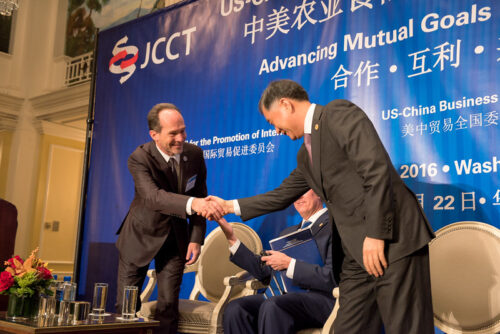
Tuesday, November 22, USCBC hosted the third annual food safety seminar on the margins of the JCCT, along with the China Council for the Promotion of International Trade (CCPIT) and the US-China Agriculture and Food Partnership (AFP). First held in 2014 in Chicago, the seminar is a forum for American and Chinese companies to talk about cooperative ways to improve food safety. The 2016 seminar focused on: strengthening consumer protection and enhancing public confidence in the supply chain; transparency and implementation of food safety regulations; and international best practices on preventing and responding to food safety incidents.
Chinese Investment in Hollywood: Focus on Opportunity
Current anxieties are overblown and the scale of Chinese investment in Hollywood is far from a threshold where it could undermine its diversity and openness. More importantly, these investments create jobs and present tremendous opportunities for US entertainment companies.
USCBC hosts Reception and Dinner in Honor of the 2016 US-China JCCT
On Monday, November 21, USCBC and the US Chamber of Commerce held a reception and small dinner in honor of the 2016 U.S.- China JCCT. The reception and dinner was attended by Vice Premier Wang Yang and his delegation and also joined by Commerce Secretary Penny Pritzker, US Trade Representative Michael Froman, USCBC Chair Mark Fields, and other member company representatives.
China Business Review (Archive Only)
Sulaiman Kenyatta
Purchasing real estate in China can be a complex procedure. Because there are so many eligibility requirements for a mortgage and to buy real estate, it’s important for investors to be aware of the differences between owning real estate and land rights in China.