Member Exclusive
Trump-Xi Summit Offers Initial Framework, But Implementation Remains Unclear
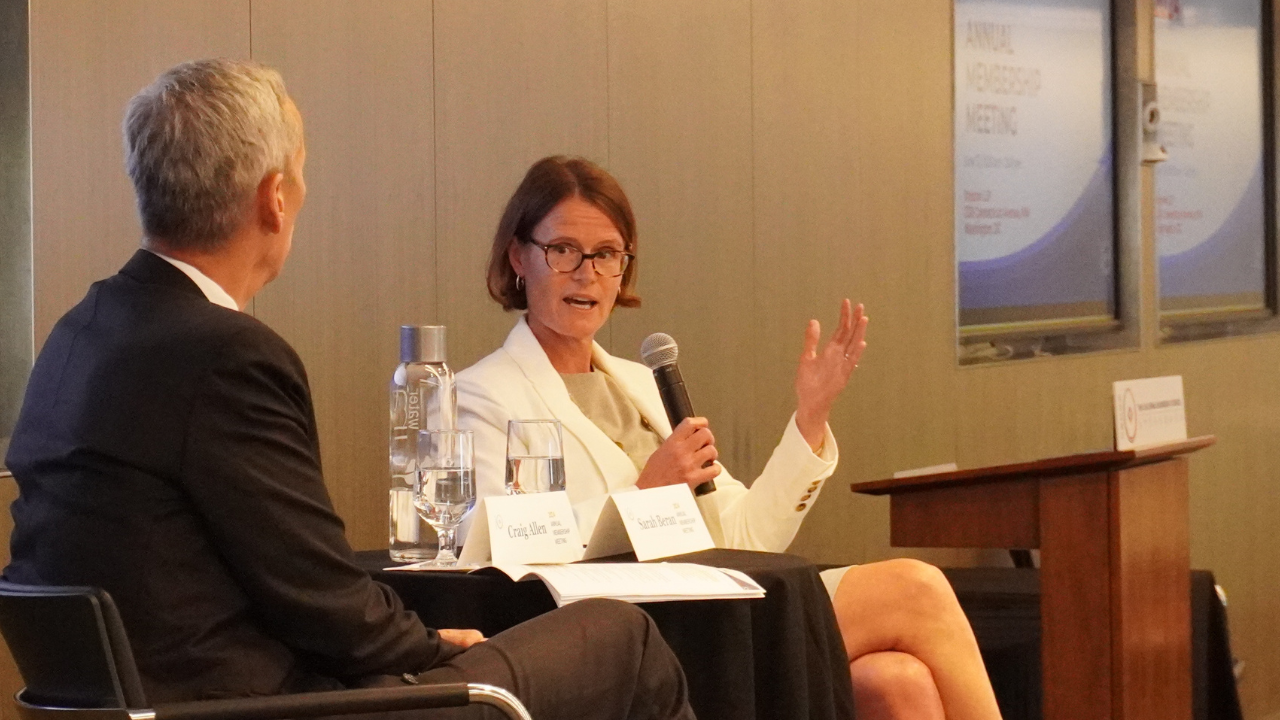
Sarah Beran leads the China practice and is a partner at Macro Advisory Partners, a geopolitical risk and strategic advisory firm. Prior to joining MAP, Sarah had a distinguished 23-year career in the US Foreign Service, most recently serving as deputy chief of mission at the US Embassy in Beijing and as senior director for China and Taiwan affairs at the White House National Security Council under President Biden. During her time at the State Department, Sarah also served as deputy executive secretary for the Indo-Pacific, led the office responsible for US engagement in APEC, and served as director of the Office of Chinese and Mongolian Affairs.
Behind-the-scenes meeting prep is always much more chaotic than it appears from the outside. I’ve seen this from both sides — I was on the ground in Beijing in the run-up to and during President Trump’s 2017 state visit to Beijing, and I oversaw preparations for President Biden’s meeting with President Xi in the United States in 2023.
Six weeks to two months ahead of a meeting between presidents, logistics take over, particularly for travel. A state visit involves around 900 people flying from the United States to China, multiple planes, transport of heavy equipment, and security. Negotiations on the shape of that logistical support package take up an incredible amount of time between the Ministry of Foreign Affairs and the US embassy. I expect this logistical prep is starting to dominate the conversation between the two sides, even if a date for the trip has not yet been finalized. For Trump’s last visit, Chinese officials were under instructions to do everything possible to make it a smooth and successful visit. But even then, the day-to-day wrangling and negotiations over every single possible detail took a tremendous amount of time for the embassy and the White House.
A key challenge for US government officials right now is how to ensure they are focusing on substance, not just logistics and protocol, for this trip.
It is important to carve out space and time for substantive prep work on what the two leaders will discuss, how to push the envelope, and any deliverables the two sides can announce. This requires interagency coordination on both sides before the meeting. For example, if the United States is seeking additional, meaningful commitments on counternarcotics, that will require internal US government coordination between the Drug Enforcement Administration, the Department of Justice, and the White House on specific asks, as well as coordination with China’s Ministry of Public Security and Ministry of Foreign Affairs on law enforcement actions. A general commitment to simply “do more to stop the flow of precursor chemicals” does not effect change in the Chinese system.
That all takes time. While it sometimes seems like you can just flip a switch and somebody gets on a plane, it’s not that easy when on a presidential visit. Taking the time to focus on substance in addition to logistics is critical to make this a meaningful visit.
Past practice is probably not a good guide. Substantive negotiations for a presidential visit were previously handled through the National Security Council (NSC) — the national security advisor to his counterpart, Wang Yi, the foreign minister and director of the Office of the Central Foreign Affairs Commission. The negotiations channel was the NSC senior director to the assistant minister or vice minister equivalent in the Chinese foreign affairs ministry, as well as the US embassy. If a company wanted to raise an advocacy issue in the past, the NSC or US embassy were appropriate channels.
In the absence of negotiation channels this time, the most effective channel is probably through the US embassy, or the US ambassador in Beijing. They are the lead on logistics and likely serve as a coordination point in the absence of any policy coordination process.
On the Chinese side, the run-up to a state visit is one of the only times that the foreign ministry is empowered to reach across different ministries and work toward deliverables. Depending on the issue, this means engagement with the Americas division at the foreign ministry could be important, in addition to line ministries. But this can be a fraught question, and it really depends on the issue.
What comes out of the summit is constrained to some degree by each side’s vision of the other’s long-term strategic objectives. By that, I mean if China’s long-term strategic view of the United States is that Trump is interested in and can maintain a reset and hand it off to another administration, and that the trajectory of the relationship will fundamentally change, then this could motivate Beijing to take steps that would result in a reset.
There is a sense that while the president has imposed discipline on the interagency, the administration could take new measures targeting China after the meeting.
But what I am hearing from the Chinese side is that strategic mistrust persists, there is a lack of understanding of where the Trump administration is on key questions like Taiwan, and there is a sense that while the president has imposed discipline on the interagency, the administration could take new measures targeting China after the meeting. That is limiting the Chinese side’s interest in taking additional steps that could fundamentally change the direction of the relationship.
On the US side, I don’t think there is a consensus on what the administration’s China policy is or what the long-term strategic direction of the relationship is, and that makes it hard to envision anything other than tactical steps resulting from this meeting.
The discrepancies are significant. If the two sides describe the outcomes differently, then that previews where the friction will be. After the October 2025 meeting between Trump and Xi, the two statements characterized the agreement on rare earth export licenses differently. The US then quietly changed its statement on the White House website a week later, without any public announcement and I suspect under Chinese pressure, to reflect what actually had been agreed upon.
I would watch carefully how both sides characterize the duration of the truce, which is set to expire in November.
Often, with presidential meetings, some outcomes are publicly announced, while there are other no-profile agreements or understandings. These no-profile understandings emerge through press reporting, leaks, and carefully watching behavior change from both sides after the meeting. For example, it is clear that the US made a non-public agreement to hold off on China-related actions after the Busan meeting.
For the April meeting, I would watch carefully how both sides characterize the duration of the truce, which is set to expire in November.
I’ve served in five different countries, and Chinese officials are by far the toughest negotiators I’ve ever dealt with. I think anybody who has worked on US-China issues will tell you the same. It’s important to have a written text and to know what has been negotiated in the past to both understand where the loopholes are and prevent the Chinese side from exploiting them. So, my advice to US negotiators: be prepared, do your homework, and make sure you have a written text.
Optics matter. We oftentimes overlook it. Because China is such a centralized, top-down system, Americans often believe that public opinion doesn’t matter or that the leader can make things happen. Certainly, Xi Jinping has incredible power and authority to make things happen, but he exists in his own political environment. So, in the lead-up to a meeting, it is important to watch the Chinese public narrative about the relationship. The Chinese side wants to ensure that there are no negative media stories — military exercises, arms sales, or other activities that their system will interpret as anti-China — because that will make it more difficult to craft a narrative that the Chinese leader is engaged in important, meaningful diplomacy that brings results for the Chinese people. You’ve got to think about their information space and how they’re seeking to demonstrate positive optics — this helps enable a positive outcome for both sides.
I am concerned that focusing solely on the economic and trade issues and not engaging with China on national security issues creates long-term vulnerabilities.
The reality of the relationship is that it is very complicated. There are positive aspects, but there are also negative, difficult topics that the US and China should be discussing. I expect the Trump administration is focused on the need for positive optics in the run-up to the meeting, but I am concerned that focusing solely on the economic and trade issues and not engaging with China on national security issues creates long-term vulnerabilities.
I think you would get a different answer from anyone you talk to in the US administration. Some argue that it is impossible to force change on China from the outside. I don’t disagree with that, but I think it is still important to give voice to the longer-term structural concerns and make that part of the conversation, even if you’re not expecting China to change because of outside pressure.
I would not expect Chinese officials to raise this directly at a leader level in a meaningful way. Beijing sees these meetings as a way to manage the president, and I think their goal is stability through small steps, like commitments to buy soybeans, possibly Boeing aircraft, and other exports.
The use of rules of origin and other trade measures to limit the transshipment of Chinese goods through third countries to the US is not new. The US has tried to do that for some time using different tools — trade agreements, national security measures, export controls — to limit the impact of China’s non-market trade practices on the US economy. China will publicly complain about it, but I think it is expected.
Frankly, other countries are using this pressure to advance their own interests. Rules of origin, for example, can allow Southeast Asia to add requirements that China move meaningful manufacturing, not just reassembly, to host countries to provide jobs and economic growth opportunities. So, there’s some overlapping interest with US trade partners.
On geopolitical issues like Greenland and Venezuela, I think China will largely refrain from direct confrontation with the US. Instead, China will use it as a messaging opportunity to try to demonstrate that the US is disrupting the international order. Beijing will use this messaging to position itself as the long-term partner of choice and lean into economic, trade, and investment engagement with third countries, particularly in the Global South, that are seeking to hedge against US tariff risks and other pressures.