Francisco Bencosme
Director, Government Affairs
Washington, DC
Director, Government Affairs
Washington, DC
Francisco Bencosme is a director on the government affairs team at the US-China Business Council, where he helps more than 200 American companies navigate US-China issues. He was formerly the China policy lead for the US Agency for International Development, serving as principal advisor to the USAID administrator on issues relating to China and Taiwan. Prior to joining USAID, he was deputy to the Special Presidential Envoy for Compact of Free Association negotiations, helping conclude three 20-year compact agreements with Pacific Island nations. He concurrently served as senior advisor to Assistant Secretary for East Asian and Pacific Affairs Dan Kritenbrink. Before joining the Biden-Harris administration, he was a senior policy advisor at the Open Society Foundations covering Asia and Latin America and led the US human rights policy and advocacy program toward the Asia-Pacific at Amnesty International USA. He previously served as a professional staff member on the US Senate Foreign Relations Committee.
He is a Council on Foreign Relations term member, a Truman Security Fellow and a Penn Kemble Fellow. He received his master’s degree in foreign service from Georgetown University and his bachelor’s degree from Wake Forest University.
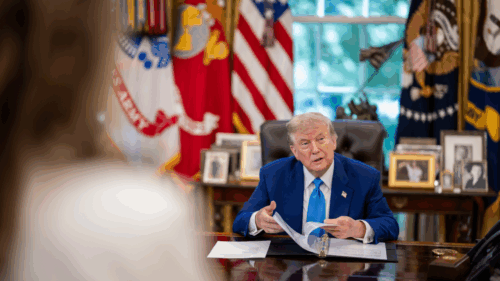
The United States and China have signed a yet-to-be-released framework capturing agreements made between chief negotiators in London last month. Trump on June 11 posted on Truth Social that the China trade deal was complete and that full magnets, and any necessary rare earths, will be supplied up front by China.

All eyes are on the Senate to pass the reconciliation tax and spending package after the House passed its version by a vote of 215–214. The so-called big, beautiful bill is aimed at making 2017 tax cuts permanent and includes provisions related to energy, health care, and other economic issues. It is a budget reconciliation bill which is designed to fast-track policy and avoid higher vote thresholds for passage. Several provisions have important US-China trade implications.