Research & Analysis

G20 Ministers Pledge to Address Overcapacity, FCC Targets Chinese Electronics Testing Labs, and USTR Extends Section 301 Tariffs
Member Exclusive

G20 Ministers Pledge to Address Overcapacity, FCC Targets Chinese Electronics Testing Labs, and USTR Extends Section 301 Tariffs

Trade ministers from 12 G20 countries, the EU, and Poland on Wednesday signed a US-led joint statement on addressing structural excess capacity. The statement does not directly mention China, but the sectors named in the document — autos and electric vehicles, batteries, chemicals, foundational semiconductors, and solar panels — are dominated by China. Six other G20 members, including China, did not sign.

Washington Update USCBC Government Affairs

Publications

China Market Intelligence

China Market Intelligence

Member Exclusive
Short takes on policy and regulatory actions that impact the business environment.

See the articles

Washington Update

Washington Update

Member Exclusive
Weekly recaps of every noteworthy development in the US legislative and executive branches.

See the articles

Filters

Close

Filter By

Topic
Format
Publication
Date

through

50 Results Clear Filters

2948 Results

Industrial Production and Investment in Manufacturing Buoy Growth in Q1
Member Exclusive

Industrial Production and Investment in Manufacturing Buoy Growth in Q1

On April 16, the National Bureau of Statistics (NBS) released first quarter economic data that paints a mixed picture for China’s 2024 economic growth. While the official NBS views the data as portraying good momentum for China’s economic rebound, many independent analysts noted that seasonal demand increases in January and February around the annual Chinese New Year holiday drove up the headline demand figures, and that March data on property investment, retail sales, and overall industrial output show signs of deceleration.

China’s Industrial Equipment and Consumer Trade-in Program: What We Know So Far
Member Exclusive

China’s Industrial Equipment and Consumer Trade-in Program: What We Know So Far

In early March, China launched a campaign to encourage businesses to upgrade their industrial equipment and consumers to trade-in their outdated goods, which includes automobiles and household appliances. The campaign is intended to address several priorities at once, including boosting consumption, raising business confidence, and improving China’s manufacturing capabilities.

China Market Intelligence Felix Li with assistance from Jie Yu
The New Proposal to Repeal De Minimis Treatment for Many Products from China
Member Exclusive

The New Proposal to Repeal De Minimis Treatment for Many Products from China

A newly approved bill from the House Ways and Means Committee has reignited the discussion over a popular trade provision utilized by those who sell and ship their goods to the United States, especially by companies in China. The de minimis rule allows products valued under $800 to be expedited at US ports without paying tariffs that would otherwise be applied.

China Market Intelligence Joseph Rafshoon
Week in Review: US Sanctions Chinese Firms Aiding Russia’s War, Moolenaar Outlines Select Committee Priorities, and AD/CVD Solar and Chemical Investigations Move Forward
Member Exclusive

Week in Review: US Sanctions Chinese Firms Aiding Russia’s War, Moolenaar Outlines Select Committee Priorities, and AD/CVD Solar and Chemical Investigations Move Forward

On Wednesday, the Treasury Department and State Department announced nearly 300 new sanctions aimed at entities circumventing US sanctions on Russia. The sanctioned entities include several Chinese firms.

Washington Update USCBC Government Affairs
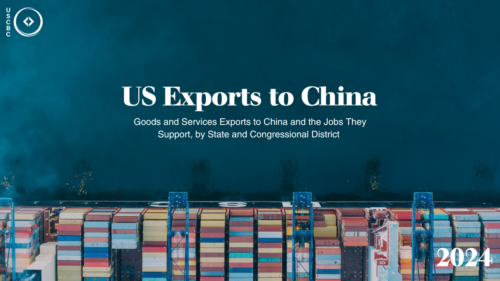
US Exports to China 2024
Export report landscape cover with a freight ship at sea.

US Exports to China 2024

This report explores the latest comprehensive data available for exports of both US goods (2023) and services (2022) to China as well as for the jobs they support.

Report
Week in Review: Biden Calls for Tariff Hikes on China, House May Soon Vote on TikTok Bill 2.0, and Committee Approves De Minimis Bill
Member Exclusive

Week in Review: Biden Calls for Tariff Hikes on China, House May Soon Vote on TikTok Bill 2.0, and Committee Approves De Minimis Bill

On Wednesday, President Joe Biden called on the Office of the United States Trade Representative (USTR) to triple the Section 301 tariff rate on Chinese steel and aluminum to 22.5 percent, up from a current average of 7.5 percent. The increased Section 301 tariffs would be added on top of an import’s regular duty rate and any existing antidumping and countervailing duties.

Washington Update USCBC Government Affairs
New Rules on Tech Broaden US Government Controls, Draw Focus to Transnational Subsidies
Member Exclusive

New Rules on Tech Broaden US Government Controls, Draw Focus to Transnational Subsidies

The Biden administration has characterized its strategy for regulating commerce with China as a “small-yard, high-fence” approach, saying it will promote what it can and protect what it must. Under this framework, access to certain dual use technologies and services is controlled, while other, non-sensitive areas are not restricted, tariffs notwithstanding.

China Market Intelligence Zach Tomatz
Commercial Issues Working Group Vice Ministerial and Yellen Visit Set Stage for Discussions on Data, Climate, and More
Member Exclusive

Commercial Issues Working Group Vice Ministerial and Yellen Visit Set Stage for Discussions on Data, Climate, and More

The US-China Commercial Issues Working Group (CIWG), the first commercial bilateral mechanism between the United States and China in seven years, recently concluded its first meeting, which took place in Washington, DC. The mechanism was created last fall, during talks between Commerce Secretary Gina Raimondo and Commerce Minister Wang Wentao, as a platform for the private sector to raise specific issues with both governments.